
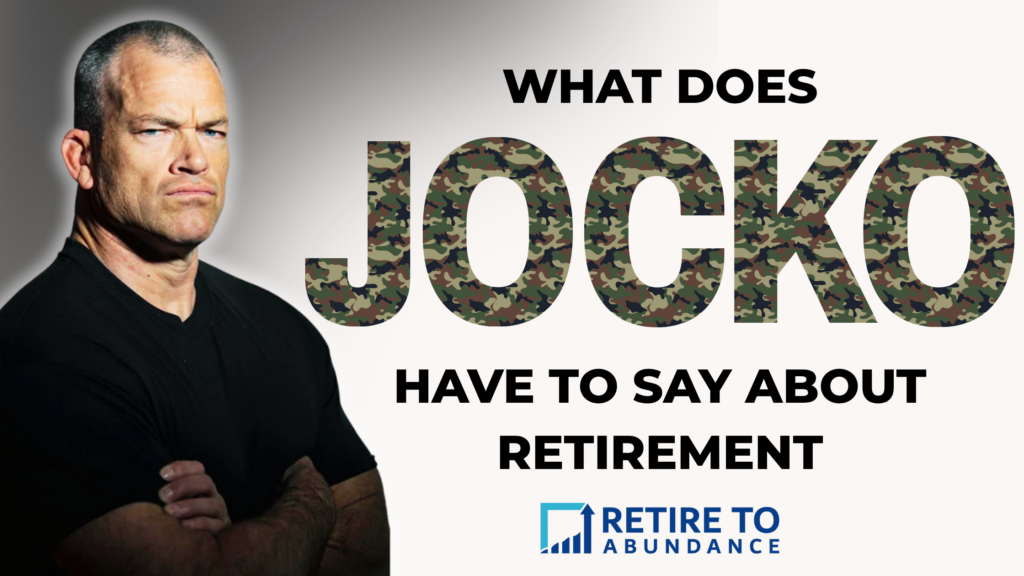
Perhaps my favorite book of all time is Extreme Ownership: How US Navy SEALS Lead and Win by Jocko Willink and Leif Babin. It’s one of the most impactful books I’ve ever read. So much so that I read through it and discussed it with my older kids when they were 10, 8, and 6. We still talk about the principles today and try to live them out in our home. I’ve gifted the book to many people and recommended it to countless others.
So…what does Jocko, a Navy SEAL and leadership guru, have to say about retirement?
Well…a lot actually.
While I think all the different sections of the book are fantastic and could have a great impact on your retirement plan, today I want to focus on his chapter titled “Prioritize and Execute”.
It’s a simple idea.
But simple doesn’t mean easy.
The Problem: Everything Feels Important
When people get within five to ten years of retirement, something interesting happens.
Everything starts to feel urgent.
- “Should I take Social Security now or later?”
- “Do I need to adjust my investments?”
- “What about taxes?”
- “Should I be doing Roth conversions?”
- “Are we spending too much?”
It all piles up at once.
And when everything feels important, people tend to do one of two things: They either freeze…or they bounce from one decision to the next without ever fully solving any of them.
Neither works. Obviously.
This is exactly the kind of environment where “Prioritize and Execute” becomes incredibly valuable.
Because the reality is: Not everything is equally important. Prioritize…and Execute.
Prioritize: What Actually Matters Most?
If you strip retirement planning down to its core, there are only a handful of decisions that truly drive outcomes.
The problem is that they often get buried under layers of complexity.
At a high level, most people should be thinking about things in this order:
1. Income
Where is your paycheck coming from once you stop working?
2. Expenses
What does life actually cost, and what do you want it to cost?
This is one of the most overlooked pieces. You can have a great income plan, but if spending isn’t aligned, the plan won’t hold. On the flip side, even small adjustments here can create a lot of flexibility elsewhere.
3. Taxes
How do you minimize what you pay over time, not just this year?
4. Investments
How should your portfolio support the plan you’ve already built?
That’s it.
Everything else matters, but it doesn’t come first. If you get these four things right, you’re in a very strong position. If you get them out of order, things start to break down quickly.
Execute: Do the Work That Actually Moves the Needle
Once you’ve identified the priority, the next step is execution.
This is where things often fall apart. Because execution requires discipline.
It means sitting down and actually answering the hard questions:
- What does our retirement income look like year by year?
- What do we actually need (and want) to spend?
- When does it make sense to take Social Security?
- How do we draw from our accounts in a tax-efficient way?
These aren’t always exciting conversations. They don’t always come with quick wins.
But they are the decisions that define your retirement.
And here’s the key:
A simple plan, fully executed, will always outperform a complex plan that never gets implemented.
When Complexity Costs More Than It Saves
I see a version of this play out every single year: A business owner has a strong income year and is looking for ways to reduce taxes. Late in the year, they purchase a piece of equipment they don’t really need, largely because of the tax benefits.
Let’s say they spend $80,000 and save around $20,000 in taxes.
On paper, that feels like a win.
But step back for a second. They didn’t just save $20,000…they spent $80,000 to do it.
That’s $80,000 that could have gone toward long-term investments, future income, or building flexibility into their plan.
Instead, it’s now tied up in something they didn’t truly need.
The strategy worked exactly as intended. Taxes were reduced. But the more important question never got asked:
Was that the best use of that money?
That’s the tension.
Because in many cases, accepting a reasonable tax bill and directing that cash toward long-term goals leads to a much stronger outcome.
Why Simple Wins: The Role of Occam’s Razor
There’s a principle known as Occam’s Razor, which essentially says: The simplest solution is often the best one.
Now, that doesn’t mean every financial plan should be overly simplistic. There are absolutely situations where more advanced strategies make sense.
But in my experience, complexity is often overused. And more importantly, it often gets in the way.
Overly complex strategies can cloud what actually matters, create hesitation and second-guessing, and make it harder to stick with the plan over time
And sticking with the plan is everything.
The Discipline to Stay the Course
This is where everything starts to come together.
Simplicity isn’t just a preference. It’s what makes “Prioritize and Execute” work over time.
Because when you truly prioritize, something happens: Things get simpler.
You’re no longer trying to solve everything at once. You’re not chasing every opportunity or reacting to every headline. You’ve identified what matters most, and that clarity cuts out a lot of the noise.
And when things are simpler, execution becomes much more realistic.
It’s easier to:
- Stick with a clear income plan
- Follow through on a thoughtful tax strategy
- Stay disciplined with your investments
This is one of the reasons we take a more passive, research-driven approach to investing. A disciplined approach.
Not because it’s trendy. Not because it’s the only way. But because it supports the plan instead of distracting from it.
A simpler approach reduces the temptation to constantly adjust, second-guess, or react. And that matters, because…
The best plan in the world doesn’t matter if you can’t stick with it.
Simplicity helps you prioritize. Prioritization makes execution possible. And execution is what ultimately drives results.
Simple Doesn’t Mean Easy
It’s worth saying this clearly.
This approach is simple.
It is not easy.
Prioritizing requires saying no to things that feel important but aren’t. Execution requires doing the work, even when it’s not exciting. Sticking with the plan requires discipline, especially when emotions start to creep in.
That’s where most people struggle. Not because they don’t have access to good information. But because they don’t have a framework for cutting through the noise.
Jocko’s Leadership Advice….For Retirement
“Prioritize and Execute” isn’t just a leadership principle. It’s a practical framework for making better financial decisions.
You don’t need to solve everything at once. You don’t need a perfectly optimized, overly complex plan. You need clarity on what matters most, and the discipline to follow through.
Because at the end of the day, a clear income plan beats a scattered one. A realistic expense plan beats an assumed one. A thoughtful tax strategy beats a reactive one. A simple, disciplined investment approach beats constant adjustment .
And most importantly…
A plan that gets executed will always beat one that doesn’t.
That’s how you cut through the noise. That’s how you make real progress. And ultimately, that’s how you build a retirement plan that actually works.
This post is for education and entertainment purposes only. Nothing should be construed as investment, tax, or legal advice.